
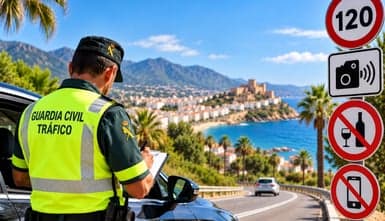
Traffic Fines and Rules in Spain: What Drivers Need to Know
Living on the Costa del Sol, or visiting regularly, usually means getting behind the wheel sooner or later – the region is increasingly well served by public transport, but plenty of destinations between Málaga, Marbella and Manilva are simply too far apart to manage without a car. And with driving comes the question of how the Spanish fine system actually works, usually prompted by a letter from the DGT (Dirección General de Tráfico, Spain's traffic authority) showing up in the post, or an unexplained charge appearing on a rental car credit card bill.
The Spanish system differs from what visitors from the UK, Germany or the Netherlands are used to in a few important ways: which stretches of road carry speed cameras, how points work for foreign licence holders, and above all how quickly a modest fine can double if it isn't paid promptly.
The points system (carnet por puntos)
Since 2006, the Spanish driving licence has been tied to a points system: every driver starts with 12 points, with different totals for professional drivers and new licence holders. More serious offences – significant speeding, using a phone while driving, drink-driving – carry a points deduction on top of the fine itself, while minor infractions are penalised with the fine alone.
For holders of a Spanish licence (or residents who have exchanged an EU licence for a Spanish one), deducted points are recorded directly against the licence in the DGT's system and affect its validity over time. For tourists and short-term visitors driving on a foreign licence, the Spanish points system doesn't apply directly – the fine itself is still payable, but the points aren't transferred back to the driver's home-country licence, since there's no automatic points-exchange agreement between Spain and most other countries, unlike the arrangements that exist for recovering unpaid fines. In practice, this means a British or German driver caught speeding in Spain pays the fine but doesn't lose points on their home licence – the financial consequence, however, is exactly the same.
The fines that most often catch foreign drivers out
Some rules are enforced more consistently in Spain than many visitors expect, and these are the ones that most reliably generate an unexpected letter from the DGT.
Using a phone, even just to glance at it while stopped at a red light, carries a fine of €200 and six points – one of the highest penalties in the entire fine schedule, and notably stricter than in many other European countries. Simply holding the phone is enough to trigger the fine, regardless of whether a call is actually in progress.
Seatbelts are compulsory in every seat, including the back, with a €200 fine for non-compliance. Children under 135cm must travel in an age-appropriate car seat; a missing or incorrectly fitted car seat also carries a €200 fine plus points.
Illegal parking is enforced noticeably consistently by the Policía Local in the Costa del Sol's tourist towns – Marbella, Fuengirola, Estepona, Puerto Banús – particularly in the blue-marked zona azul areas, where a paid ticket from the pay-and-display machine is compulsory. Parking without a valid ticket risks a fine of between €80 and €200, and in the narrow streets of the old towns it also risks being towed by the grúa, which adds towing and storage fees on top.
Driving in a bus or taxi lane, usually marked with yellow paint or the words BUS-TAXI, carries a €200 fine and four points, and on the Costa del Sol this is increasingly enforced by camera rather than by patrol officers.
Speed limits
On the motorway (autopista, usually tolled, identified by the AP prefix) and the dual carriageway (autovía, toll-free, A prefix – the A-7 being the main coastal route from Málaga to Gibraltar), the general limit is 120 km/h. On ordinary roads outside built-up areas (carreteras convencionales) it's typically 90, occasionally 100 km/h depending on the road's standard, dropping to 50 km/h within built-up areas and as low as 30 km/h in many old-town centres and traffic-calmed zones (zonas 30).
Fines rise progressively with the scale of the excess: within built-up areas, exceeding the limit by up to 20 km/h already costs €100, while exceeding it by more than 50 km/h can cost up to €600 and risks losing the licence altogether. The many fixed speed cameras along the A-7 and AP-7, together with mobile checks run by the Guardia Civil de Tráfico, often from unmarked vehicles parked at the roadside, make speeding one of the most commonly penalised offences on the Costa del Sol.
Drink-driving
The legal limit in Spain is 0.5g/l of blood alcohol for most drivers, dropping to just 0.3g/l for new licence holders (within their first two years) and professional drivers – stricter than the UK limit and broadly similar to Germany's. In practice, roadside checks are carried out with a breathalyser, and the fine itself is set according to the breath-alcohol reading rather than the blood limit: a reading of between 0.26 and 0.50mg/l carries a fine of €500 and the loss of 4 points, a reading above 0.50mg/l carries a fine of €1,000 and the loss of 6 points, and a reading above 0.60mg/l can turn the matter into a criminal rather than administrative offence, with potential imprisonment, a fine, community service and disqualification from driving. Mobile breathalyser checks on the Costa del Sol are common at weekends and near nightlife areas such as Puerto Banús or Marbella's old town.
How fines are delivered
For a car registered in Spain, a fine notice is sent by post to the address held on file with the DGT, with a growing number of drivers now registered for the Dirección Electrónica Vial (DEV), a digital mailbox that delivers notices faster and without paper.
A rental car works differently. When a fixed or mobile camera captures the vehicle, or it's photographed parked illegally, the authority initially identifies only the number plate and contacts the rental company as the registered keeper. The rental company then passes the actual driver's details on to the DGT, and almost always adds its own administration fee, typically between €20 and €40, charged directly to the card on file for the rental – often weeks or even months after the trip itself, which is why the fine tends to appear unexpectedly on a credit card statement long after the holiday is over.
Paying a fine: the DGT portal and the early-payment discount
Fines issued by the DGT itself – speeding, phone use, seatbelt and drink-driving offences, and anything recorded by the Guardia Civil or a state-run camera – can be paid directly online through the DGT's official payment portal (sedeclave.dgt.gob.es) by card, once the notice number is known, or in person at any Spanish bank branch. Not every fine goes through the DGT, though: a parking ticket in a zona azul, for instance, is issued by the local town hall rather than the DGT, and must be paid according to the instructions printed on the notice itself, usually directly to the council rather than through the DGT site. Paying a DGT-issued fine within 20 calendar days of the notice being issued earns a 50% discount on the base fine (pronto pago) – a €200 fine drops to €100. Local fines typically offer a similar early-payment discount, though the exact terms are set by the issuing council and should be checked on the notice itself. After the discount window closes, the full amount becomes due, and further delay can add late-payment surcharges and interest.
One important detail: paying at the discounted rate generally forfeits the right to later appeal the fine, since the reduced payment is treated in law as an acceptance of the penalty. For clear-cut cases – a speeding fine backed by an unambiguous camera photo, for instance – an appeal rarely succeeds anyway; where there's a genuine question over delivery of the notice or the identity of the driver, however, an appeal can be worth pursuing instead of paying early.
What happens if a fine goes unpaid
Within Spain, an unpaid fine can lead to a bank account freeze, a block on renewing the vehicle's registration at the next ITV inspection, or, in persistent cases, seizure of other assets. For visitors from other EU countries, the EU's cross-border traffic offence directive also applies: for fines of €70 or more, details can be shared with the driver's home-country licensing authority, meaning the notice can be delivered and, if necessary, enforced there as well. Simply ignoring a Spanish fine because you're no longer in the country isn't, in most cases, a reliable strategy – the outstanding debt can resurface the next time the same vehicle crosses the border, or the next time a rental is booked under the same details.
Practical tips for drivers on the Costa del Sol
Anyone using the A-7 regularly between Málaga and Estepona should know that the speed limit drops on several stretches, notably near Fuengirola and Marbella, sometimes to 80 km/h, and that these sections are enforced accordingly – an easy limit to miss after getting used to 120 km/h for most of the journey. In the centres of Marbella, Estepona and Mijas Pueblo, it's worth assuming zona 30 limits and narrow one-way streets as the default, consistently monitored by the Policía Local.
For parking in the zona azul areas along the seafront promenades and town centres, the relevant municipal parking app (most Costa del Sol towns use providers such as ElParking or Telpark) is worth having installed, since it allows parking time to be topped up remotely from a phone without having to return to the car – useful when lunch runs longer than planned.
Anyone renting a car should check the rental terms before setting off to see how the company handles forwarded fines and what administration fee applies, which avoids an unwelcome surprise on a credit card statement months after the trip. And anyone settling on the Costa del Sol long-term benefits from registering for the Dirección Electrónica Vial, so that notices arrive digitally and traceably rather than getting lost in the post or only surfacing at the next ITV inspection.
Overall, the Spanish fine system is consistent rather than arbitrary: knowing the main rules, taking speed limits and the phone ban seriously, and keeping the 20-day discount window in mind if a notice does arrive, is usually enough to navigate everyday driving on the Costa del Sol without any unpleasant surprises.
Have questions about property on the Costa del Sol? We're happy to help.
Get in Touch