Inheriting a Property in Spain: What International Owners on the Costa del Sol Should Know
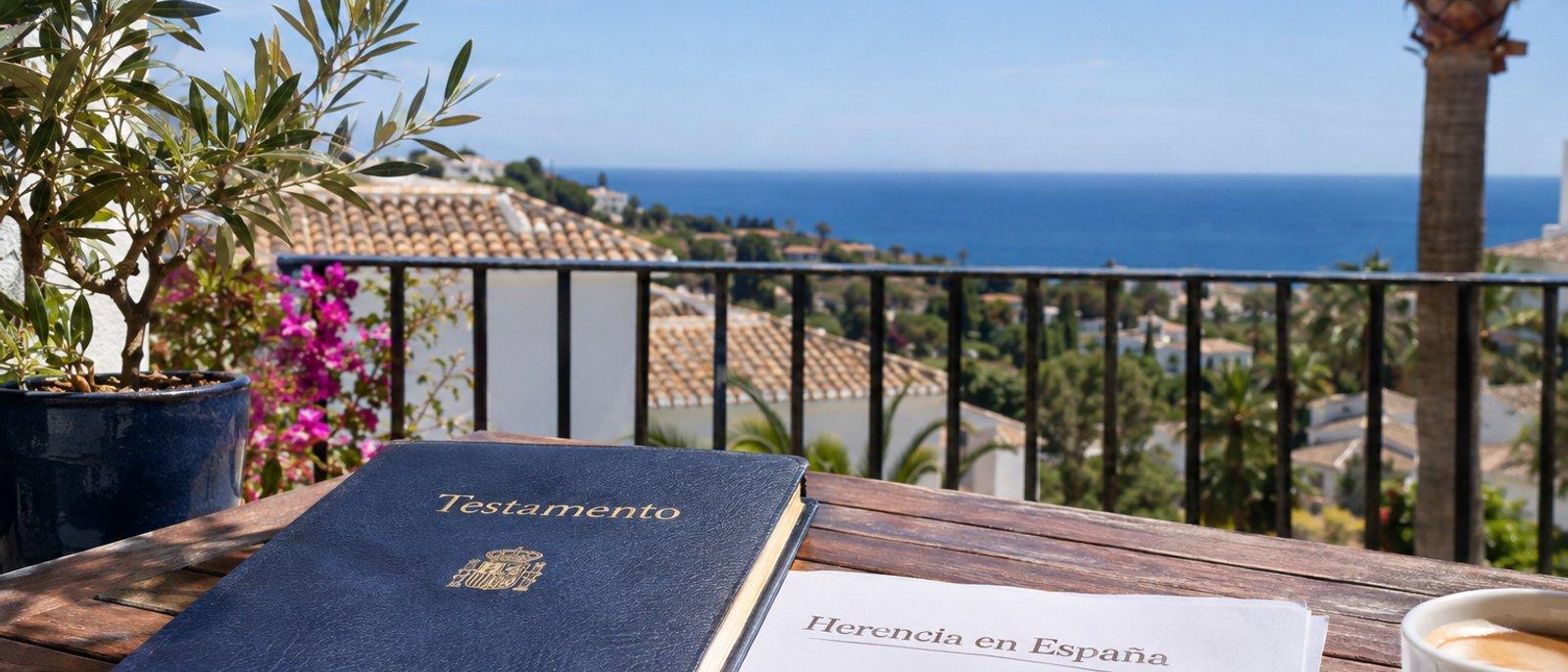
Many international owners on the Costa del Sol focus closely on the purchase price, the notary and the land registry – and only think years later, often too late, about what happens to the property when they die. Under Spanish law, a property located in Spain is generally subject to Spanish succession rules, regardless of the owners' nationality or where they are officially registered as residents. Ignoring this can leave your heirs facing a process that drags on for years and triggers Spanish forced heirship rules that hardly anyone in Germany, the UK, the Netherlands or Scandinavia expects.
The good news: with relatively little effort – one well-chosen sentence in your will, plus a Spanish will alongside your home-country one – most of these risks can be avoided. This article explains how inheriting a property on the Costa del Sol actually works legally, what the EU Succession Regulation allows international owners to do, how much inheritance tax really costs in Andalucía, and what concrete steps heirs abroad need to take.
Which law applies: the EU Succession Regulation
Since August 2015, the EU Succession Regulation (Regulation No. 650/2012, often called "Brussels IV") has governed cross-border inheritance in most EU states, including Spain – and it also matters for people from non-EU countries such as the United Kingdom. The basic rule: the law of the state where the deceased had their habitual residence at the time of death applies automatically – not necessarily the law of their nationality.
For a German or British owner who lives permanently on the Costa del Sol, this means: without a different provision in the will, Spanish succession law applies to the entire estate – including assets back home. For someone who only uses the property as a holiday home and keeps their main residence abroad, the situation is often less clear-cut than it sounds: authorities and courts assess "habitual residence" case by case, based on length of stay, social ties and personal circumstances. A clear choice of law in the will removes this uncertainty entirely.
The free choice of law: one sentence with major consequences
The Succession Regulation allows any EU citizen, and also nationals of third countries such as the United Kingdom, to state explicitly in their will that the law of their own nationality should govern their succession – regardless of where they last lived. This choice must be clearly worded, for example: "I choose the law of my nationality to govern my succession as a whole."
In practice, this clause is one of the most powerful sentences an international owner can put in a will. It ensures the same succession rules apply to the Costa del Sol property as to the rest of the estate back home, and prevents Spanish forced heirship rules from applying unexpectedly – a point that matters especially for owners from countries with full testamentary freedom (the UK, the Netherlands, the Nordic countries).
Spanish forced heirship: a culture shock for many foreign owners
If Spanish law is not explicitly opted out of, the so-called "legítima" applies – mandatory forced heirship rules that, in most of Spain (Andalucía included), reserve two thirds of the estate for the children, regardless of what the deceased actually wanted. Only one third ("tercio de libre disposición") can be freely distributed, and a further third ("tercio de mejora") can be unevenly split among the children but not given to anyone outside the family.
For British, Dutch or Scandinavian owners used to leaving their estate entirely as they wish – for instance entirely to a surviving spouse, bypassing adult children from a first marriage – this rule often comes as a surprise. Blended families who want to protect a surviving partner first, before the rest passes to the children, also run into statutory limits that simply don't exist under their home law. Anyone who doesn't clarify this in advance with a Spanish notary or lawyer risks the very person they wanted to protect financially ending up in a dispute with the other heirs over the house.
Why a Spanish will is almost always worth having
A will made in Spain ("testamento abierto") doesn't replace a will made back home – both can exist side by side, as long as they don't contradict each other and each clearly covers the assets in its own country. The effort involved is modest: a short appointment with a Spanish notary, usually with two witnesses or a sworn translator if the testator doesn't speak Spanish, typically costing between €60 and €120.
The benefit is considerable. A Spanish will is automatically registered in the central wills register ("Registro General de Actos de Última Voluntad") in Madrid. After death, the notary can check within days, using a current death certificate, whether a Spanish will exists, and begin the inheritance process ("aceptación y partición de herencia") – often within a few weeks. Without a Spanish will, the heirs first need to obtain the foreign will (or a grant of probate or similar document), have it officially translated into Spanish and apostilled, before a Spanish notary can act at all.
The long road without a Spanish will
Without a Spanish will, the inheritance process is typically delayed by several months – longer in more complex cases. Heirs generally need: the original foreign will or court-issued proof of inheritance, a certified Spanish translation by a sworn translator authorised in Spain, the Hague Apostille (or, for some EU states, a European Certificate of Succession), and in some cases a legal opinion on the applicable foreign succession law for the Spanish notary to review.
During this time, the property remains formally registered in the deceased's name, running costs such as IBI (property tax), community fees and insurance still have to be paid, and a sale is effectively blocked. For holiday homes that are barely visited for years at a time, this delay often causes unnecessary friction between heirs – a risk a €100 notary appointment would have avoided entirely.
Spanish inheritance tax: the state, the region, and Andalucía's role
Spanish inheritance tax ("Impuesto sobre Sucesiones y Donaciones") is a national tax, but its actual shape – allowances, rates, reductions – is set by the autonomous regions. That means a property on the Costa del Sol falls under Andalucía's rules, which, following a major 2018 reform, are among the most favourable in Spain. For heirs in Groups I and II (children, grandchildren, spouses, parents), Andalucía first grants a reduction of the taxable base of up to €1,000,000 per heir. If the inherited share is below this, virtually no inheritance tax is due. Beyond that, the same heir groups also benefit from an additional 99% rebate on whatever tax liability remains – regardless of the size of the estate, so this applies even to significantly higher-value villas or multiple properties. In practice, this means most spouse and children inheritances of Costa del Sol properties pay little or no inheritance tax in Andalucía, even at the upper end of the market.
Non-residents: equal treatment thanks to EU law
Until 2015, Spain generally applied the less favourable national rules, rather than the regional benefits, to non-resident heirs – a practice the European Court of Justice ruled, in Commission v Spain (C-127/12), to be a breach of the free movement of capital. Since then, EU and EEA citizens have been entitled to the same regional allowances and rebates as Spanish residents, regardless of where they live. Following a legal change in 2021/2022, this equal treatment was also extended to heirs from third countries such as the United Kingdom, Switzerland or Norway, provided the property is located in Spain.
For international owners on the Costa del Sol, this means in practice: even someone who was never registered as a resident in Spain still benefits, when inheriting their holiday home, from Andalucía's generous allowances – a detail many foreign heirs still don't know about, and one that's often only explained by their local tax advisor once the process is already underway.
Unmarried couples: Parejas de Hecho
Unmarried couples who have lived together on the Costa del Sol for years, or who jointly own a property there, should look into inheritance particularly carefully. Without a registered civil partnership ("pareja de hecho") in the relevant register for the province of Málaga, a partner has no statutory inheritance rights at all – without a will, a surviving partner receives nothing under intestate succession, even after decades together.
If the partnership is properly registered as a "pareja de hecho", however, it is treated as equivalent to a marriage for Andalucía's inheritance tax purposes, and benefits from the same generous allowances and 99% rebate as Group II. Registration does not replace a will, though: it only affects the tax treatment, not statutory inheritance rights. For unmarried couples, a will with an explicit mutual bequest isn't optional – it's essential.
Deadlines: the six-month rule
Inheritance tax must be self-assessed and paid within six months of the date of death (Modelo 650). This deadline applies regardless of whether the heirs live abroad or have even formally accepted the inheritance yet. A one-off six-month extension can be requested from the relevant tax office, but the request must be filed in writing within the first five months after the date of death – miss that, and the option is lost.
If the deadline is missed without an extension, surcharges and late-payment interest apply, increasing the longer the delay continues. Since international inheritance cases – gathering documents, translations, apostilles – typically take time, it's wise to bring in a Costa del Sol gestor or lawyer who specialises in inheritance early on, to keep track of deadlines and request the extension in good time if needed.
Worked example: inheriting a holiday apartment in Estepona
To illustrate: a German couple owns an apartment in Estepona with a value of €450,000 for inheritance tax purposes. If one spouse dies and the surviving spouse inherits alone, the inherited value is well below Andalucía's €1,000,000 Group II allowance – no inheritance tax is due, only a formal nil return needs to be filed on time.
If instead two adult children each inherit half (€225,000 each), that amount is also comfortably under the individual €1,000,000 allowance per heir – again, the tax bill is zero. Even for significantly higher-value villas, the tax burden for spouses and children stays low thanks to the additional 99% rebate – the picture changes when siblings, more distant relatives or unrelated people inherit: these groups face the regular, much higher tax rates without the generous Group I/II benefits, which makes early advice particularly worthwhile in those situations.
Marital property regime and spouses: the "gananciales" quirk
Couples married under the Spanish community-of-property regime ("sociedad de gananciales"), or who bought a property explicitly under that regime, first need to dissolve the joint property ("liquidación de gananciales") before the actual inheritance can be divided – the surviving spouse automatically retains ownership of half the property, and only the other half forms part of the deceased's estate. This step is dealt with within the notarial inheritance deed, but it noticeably changes the basis for calculating inheritance tax, and should be made clear to the notary and tax advisor from the outset, especially if the original purchase deed wasn't entirely clear on the point.
Selling an inherited property on the Costa del Sol
Many heirs decide to sell the inherited property rather than keep it – whether because they live abroad themselves, because several heirs would jointly own it, or simply because no one in the family wants to use it. A sale is generally straightforward, but it requires the inheritance to be formally settled first: proof of inheritance or the will being opened, the notarial deed of acceptance and division of the estate, payment of inheritance tax, and re-registering the property in the heir's or heirs' name at the land registry. Only once the heirs are registered as the new owners can the property be validly sold – selling directly "out of the estate" without this re-registration isn't possible.
Two further taxes apply on a later sale, distinct from inheritance tax: the municipal capital gains tax mentioned earlier (Plusvalía Municipal), which now arises a second time – this time on the increase in value between the inheritance and the sale – and tax on the gain between the value used for inheritance tax purposes and the eventual sale price. For heirs resident in Spain, this gain is taxed through ordinary income tax; for non-resident heirs, through the non-resident tax (19% for EU/EEA citizens, 24% for third-country nationals). If co-heirs can't agree on a sale, any one of them can apply to the courts for a forced partition sale – but in practice it's almost always worth seeking an amicable solution first, using a professional property valuation as a basis for negotiation.
Checklist: what international owners should clarify now
Before the worst happens, it's worth taking a brief but thorough stock of the situation. A Spanish will with an explicit choice of home-country law should be made with a Spanish notary, ideally soon after buying the property rather than years later. Your own NIE number, and those of your intended heirs, should be current and easy to find, since they're needed for any inheritance process. The marital property regime under which the property was bought should be clearly documented in the purchase deed. Unmarried couples should also check whether registering as a "pareja de hecho" makes sense. Owners should additionally decide in advance which local tax advisor or lawyer should be contacted in the event of death, rather than leaving that decision to the heirs during an already difficult time. And finally, a simple list of all Spanish assets – property, bank accounts, vehicles – should be kept somewhere accessible to the family, so nothing gets overlooked when it matters most.
Inheriting a property on the Costa del Sol doesn't have to be a complicated or expensive process, provided the key decisions are made in good time. A Spanish will with a clear choice of law, an understanding of Andalucía's generous allowances, and attention to the six-month deadline protect not just the property itself, but above all the family, from unnecessary stress during an already difficult time.
Have questions about property on the Costa del Sol? We're happy to help.
Get in Touch