Halloween in Spain: How It's Celebrated, and What Is Día de Todos los Santos?
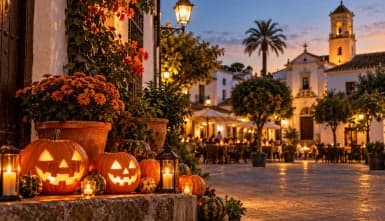
Anyone out and about on the Costa del Sol in late October will notice pumpkins appearing in shop windows, costumed children in shopping centres, and Halloween parties advertised in bars from Marbella to Fuengirola. At the same time, many Spanish families are preparing for something quite different: a visit to the cemetery on 1 November, chrysanthemums in hand. The two occasions sit just a day apart but have little to do with each other, and newcomers to Spain often mix them up.
Two different holidays, one weekend
Halloween, on the evening of 31 October, is a relatively recent import to Spain, spreading mainly since the 1990s and 2000s through American films, theme parks such as PortAventura, and international schools. It isn't an official holiday: shops and public offices stay open as normal, and many older Spaniards barely register it.
1 November, by contrast, Día de Todos los Santos (All Saints' Day), is a nationwide public holiday (festivo nacional) with centuries of tradition behind it. On this day, families visit the graves of deceased relatives, clean the headstones and lay fresh chrysanthemums – in Spain, the flower is so closely associated with remembrance of the dead that it's practically never given as an ordinary gift. In many regions the day also involves eating traditional sweets such as huesos de santo (marzipan-filled rolls) or buñuelos de viento (small fried dough balls).
Because 1 November is a public holiday, banks, government offices, most shops and many smaller restaurants close, much as they would on a Sunday. Supermarket chains and shopping centres in the more touristy parts of the Costa del Sol often stay open, sometimes with reduced hours, but anyone planning an errand at a public office on 1 November should move it to a different day.
How Halloween is actually celebrated today
Over the past few years, Halloween has become firmly established in the Costa del Sol's more touristy and international communities. In Marbella, Puerto Banús, Fuengirola and Benalmádena, bars, beach clubs and restaurants regularly hold costume parties, often with live music or DJs, sometimes starting days before the actual date.
For families with children, shopping centres such as Miramar in Fuengirola or La Cañada in Marbella have become reliable spots for small Halloween activities, decoration competitions and sometimes organised trick-or-treating within the centre itself. International and bilingual schools along the coast frequently run their own Halloween days, with costumes, craft activities and small parties – for many international families, this tends to be the most dependable way to mark the occasion.
Does trick-or-treating happen in Spain?
Classic door-to-door trick-or-treating is still noticeably less common in Spain than in, say, the US, UK or Ireland, but it is growing in certain residential areas – particularly urbanisations with a large international or British population, such as parts of Calahonda, Riviera del Sol or Elviria. It's now not unusual to see costumed children knocking on doors there, especially where several neighbours have coordinated in advance over the urbanisation's WhatsApp group about who's taking part and decorating their door accordingly.
In more traditional Spanish neighbourhoods and inland village centres, such as Mijas Pueblo, Ojén or Alhaurín el Grande, the practice remains considerably less common, although costume parties at bars and local clubs are increasingly making an appearance there too.
Practical notes for international residents on the Costa del Sol
Anyone hoping to welcome trick-or-treaters on their own street is best off checking the community or urbanisation WhatsApp group in advance, since participation varies considerably from year to year and street to street. A lit or decorated door has, in many mixed urbanisations, become an unspoken signal that a household is taking part.
Because 1 November is a public holiday, it's worth doing any grocery shopping or urgent errands on 31 October or 2 November instead – larger supermarkets often keep reduced hours, but many smaller shops and practically all public offices close completely. Anyone living near a cemetery, for instance in Mijas, Fuengirola or Estepona, should also expect noticeably heavier traffic and fuller car parks around it on the morning of 1 November, since visiting the graves is the main event of the day for many Spanish families.
Anyone wanting to celebrate Halloween on the Costa del Sol will now find a growing range of parties, family activities and, in the more international residential areas, door-to-door trick-or-treating too. Anyone wanting to experience the genuine Spanish tradition behind it, meanwhile, might instead take a quiet moment on 1 November for Día de Todos los Santos, with chrysanthemums, a visit to the cemetery, and the season's traditional sweets.
Have questions about property on the Costa del Sol? We're happy to help.
Get in Touch