
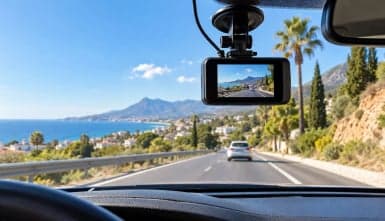
Are Dash Cams Legal in Spain? What You Need to Know
A growing number of international drivers on the Costa del Sol are fitting their cars with dash cams, usually to have evidence available in case of an accident or a dispute over who was at fault. In countries such as the UK and Germany, these devices are already widely used. In Spain, however, their use raises questions about privacy and data protection.
The good news is that dash cams are not generally prohibited in Spain. However, the legality of recording depends on how the camera is used, what it captures and what happens to the footage afterwards.
The legal basis: data protection and road safety
Dash cams in Spain are not governed exclusively by traffic regulations. Data protection legislation is also relevant, particularly when recordings include identifiable people, vehicle registration plates or other personal information.
The Spanish Data Protection Agency (Agencia Española de Protección de Datos, or AEPD) oversees compliance with data protection rules, including the EU General Data Protection Regulation (GDPR) and Spain's Organic Law 3/2018 on Personal Data Protection and the Guarantee of Digital Rights.
However, not every recording made on a public road automatically falls under the same legal requirements. Recordings made for strictly personal or domestic purposes may benefit from an exemption, depending on the circumstances. This does not amount to unrestricted permission to record, store or share images of other people.
Road safety rules also apply. A dash cam must not obstruct the driver's field of vision or create a distraction, and drivers should never adjust or operate the device while driving.
What's allowed
Using a dash cam to document your own journeys and protect yourself in the event of a road traffic incident may be lawful, depending on the circumstances. For example, footage showing how an accident occurred may help establish what happened if there is a disagreement between drivers. Many dash cams also operate in loop mode, automatically overwriting older recordings as new footage is captured.
However, the use of loop recording does not, by itself, make every recording lawful. The purpose of the recording, the way the camera is operated and whether the footage is systematically stored or used to monitor other people can all be relevant. A camera used to document a journey is also different from a device that continuously monitors a particular person, property or location, which may raise additional data protection and privacy concerns.
What's not allowed, or could cause legal problems
Problems can arise when footage is used for purposes beyond documenting your own journey. Uploading dash cam videos to social media, YouTube or other public platforms can raise legal issues if people, faces or vehicle registration plates are identifiable. Making a recording for personal use does not automatically give you the right to publish it. The legality of sharing a video depends on factors such as its content, purpose, the people identifiable in it and the legal basis for making the footage public, and consent may be relevant, though it is not the only consideration in every situation. If you want to share an accident video publicly, the safer approach is to remove or obscure identifiable faces and registration plates and consider whether publishing the footage is necessary at all.
A dash cam intended to record the road ahead should also not become a means of continuously monitoring a neighbour's property, a particular front door or other people while the vehicle is parked. The AEPD distinguishes between recording a personal journey and using a camera as a permanent surveillance system, and the latter can be subject to stricter requirements, particularly where public spaces or neighbouring properties are captured.
Audio recording deserves particular caution too. Capturing conversations involving passengers or third parties can raise additional privacy and legal issues, depending on the circumstances. If audio is not necessary, disabling the microphone is a sensible precaution, especially when other people are travelling in the vehicle.
Can dash cam footage be used after an accident?
One of the main reasons drivers install dash cams is to have a record of events if an accident occurs. Footage may be submitted to an insurer, the police or a court as supporting evidence. However, its acceptance and evidential value depend on the circumstances, and there is no guarantee that every recording will be accepted or treated as conclusive proof of who was responsible. The clarity and authenticity of the footage can be important: a recording that clearly shows the sequence of events may be more useful than one that captures only part of an incident.
If you are involved in an accident, save the relevant clip as soon as it is safe to do so, since many cameras automatically overwrite older recordings and important evidence could otherwise be lost. Keep the original file where possible, avoid editing it and make a note of the date, time and circumstances of the incident. If necessary, provide the footage to your insurer, the relevant authorities or your legal representative rather than publishing it online. Whether an insurer can use the recording to assess a claim will depend on the circumstances of the accident and the evidence available.
Practical tips for drivers on the Costa del Sol
If you are considering installing a dash cam in Spain, a few straightforward precautions can help you use it responsibly. Position the camera carefully so it does not obstruct your view of the road or interfere with safe driving, and keep the recording angle focused on the road rather than capturing more of neighbouring properties, pavements or private spaces than necessary. Loop recording, which automatically overwrites older footage, can help avoid retaining unnecessary recordings, although it does not by itself guarantee compliance with data protection law. If an accident or dispute occurs, export and save the relevant clip promptly before it is overwritten, and share footage only when there is a legitimate reason, such as submitting evidence to an insurer, the police or a lawyer.
Be cautious with interior cameras too: a camera pointed into the cabin may capture passengers and their conversations, so it's worth considering whether that's necessary and making passengers aware of it where appropriate. If you don't need audio, consider turning the microphone off, and never operate the camera while driving – set it up before starting your journey so it doesn't become a distraction.
For further guidance, the Spanish Data Protection Agency (AEPD) and the Directorate-General for Traffic (DGT) are the relevant official sources, particularly if you intend to use a camera while parked or to record anything beyond your own journeys.
So, can you use a dash cam in Spain?
In many circumstances, yes. A dash cam can be a useful way to document your journeys and preserve evidence after a road traffic incident. However, its use is not automatically lawful in every situation simply because the camera is installed in a private vehicle – what matters is not only what you record, but also why you record it, how long you keep it and who you share it with.
For international residents on the Costa del Sol, the practical takeaway is simple: use your dash cam to document your own journeys, protect the original footage if an incident occurs, and be cautious about surveillance and public sharing.
Have questions about property on the Costa del Sol? We're happy to help.
Get in Touch